
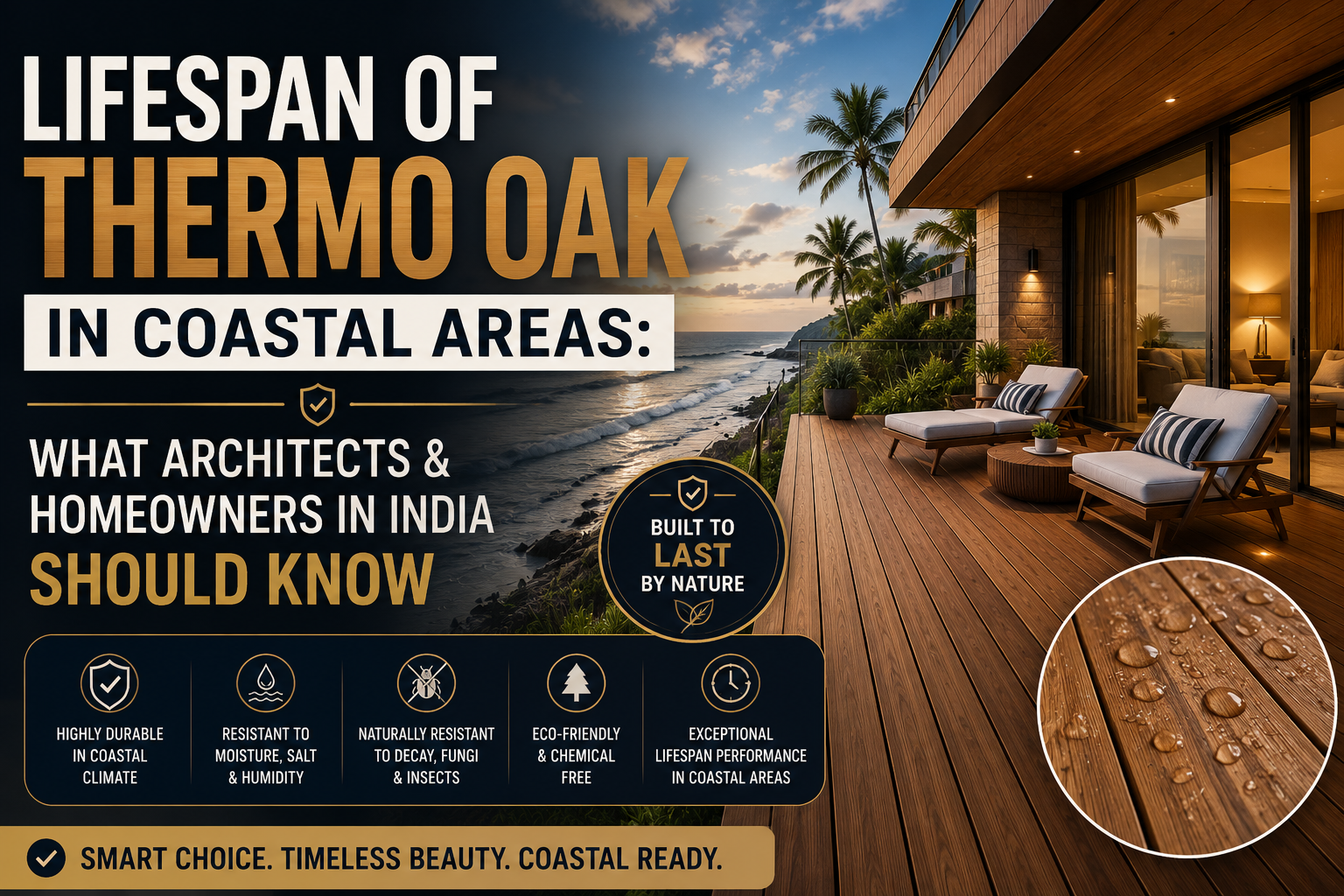
Lifespan Of Thermo Oak In Coastal Areas: What Architects And Homeowners In India Should Know
Explore how Thermo Oak performs in India’s coastal climates, offering exceptional resistance to salt air, humidity, decay, and weathering with a lifespan of up to 40 years.
India's coastline spans some of the most beautiful and climatically unforgiving landscapes in the country. From the salt-lashed seafronts of Mumbai and Visakhapatnam to the monsoon-drenched shores of Goa and Kerala, coastal environments are among the harshest conditions any building material will face. Timber, in particular, takes a serious beating.
So when architects and homeowners working on coastal projects ask how long Thermo Oak actually lasts in these conditions, the answer tends to surprise them in the best possible way.
Why Coastal Climates Are So Hard on Ordinary Timber
Three forces work against untreated wood in coastal India: salt, humidity, and biological attack. Salt particles carried in sea breezes penetrate wood grain and actively draw in moisture, accelerating decay from within. Ambient humidity levels regularly exceeding 80% in cities like Kochi, Panaji, and Chennai, create ideal conditions for fungal growth and wood rot. And the repeated expansion and contraction caused by temperature swings between seasons causes conventional timber to crack, warp, and lose structural integrity at its joints over time.
In practical terms, standard treated timber in direct coastal exposure often shows visible, significant deterioration within five to eight years. For a material positioned as a long-term investment in a premium coastal property, that is simply not good enough.
How Thermo Oak Is Built Differently
Thermo Oak undergoes thermal modification at temperatures between 180°C and 230°C, using only heat and steam in a sealed, oxygen-free environment. At a molecular level, this process breaks down hemicellulose, the component in wood's cell wall that is primarily responsible for drawing in and holding moisture. Once this is reduced, the wood's equilibrium moisture content drops dramatically. It simply no longer absorbs humidity from coastal air the way untreated timber does.
The same thermal process removes the nutrients within the wood's cells that fungi, bacteria, and wood-boring insects depend on. This biological resistance is not a surface treatment or coating, it runs through the full depth of every board, and it does not wear off, leach into the environment, or require reapplication. No chemicals. No preservatives. Just a fundamentally transformed piece of wood.
So How Long Does Thermo Oak Actually Last at the Coast?
In coastal applications, if properly installed and maintained, Thermo Oak can easily last for 25 to 40 years. Thermally modified oak achieves a Class 1–2 durability rating, the highest classification available for biological decay resistance placing it in the same category as naturally durable tropical hardwoods like teak and IPE. The Building Research Establishment (BRE) endorses a minimum 30-year service life for thermowood in exterior decking applications.
For a sea-facing villa in Goa, a coastal resort in Kerala, or a beachfront apartment facade in Mumbai, this means fewer replacements, lower lifecycle costs, and a material that continues performing long after conventional alternatives have failed.
How Thermo Oak Ages Over Time
If maintained with periodic oiling typically once every one to two years in high-exposure coastal settings, Thermo Oak retains its rich, deep-brown tone. If left untreated, which is a perfectly valid approach, the surface gradually weathers to an elegant silver-grey patina. This greying is purely a surface phenomenon. The thermal modification runs through the complete depth of every board, so structural strength, moisture resistance, and biological durability remain entirely unaffected as the wood ages. Many architects now actively specify untreated Thermo Oak for coastal projects, precisely to achieve this weathered, sophisticated finish that suits contemporary beachfront architecture well.
Where Thermo Oak Works Best in Coastal Settings
Thermo Oak is most commonly and effectively used in coastal India for outdoor decking around pools, terraces, and seafront areas where constant moisture exposure is unavoidable. It performs equally well as sustainable wood cladding on the exterior facades of beachfront villas, boutique hotels, and resort properties, where conventional timber would begin deteriorating within a few years. Garden structures - pergolas, privacy screens, boundary fencing also benefit significantly from Thermo Oak's long-term decay resistance in salt-air environments. And for interior wall panelling in high-humidity coastal homes, thermally modified oak provides the dimensional stability that prevents the warping and joint failure that plague conventional timber in these settings.
Keeping It in Good Shape: Maintenance at the Coast
One of Thermo Oak's most practical advantages is how little maintenance it actually requires. There are no chemical treatments to schedule, no risk of delamination, no toxic materials to handle. For owners wanting to preserve the original brown colour, oiling once a year or two is sufficient. For those embracing the silver-grey patina, periodic cleaning and inspection of fixings is all that is needed. The single most important installation consideration is ensuring proper drainage beneath decking boards and behind cladding systems, so water never pools directly against the timber for extended periods.
Conclusion
In India's coastal environments, where most building materials face their most demanding test, Thermo Oak stands in a category of its own. Its thermal modification addresses the root causes of coastal wood failure at a structural level. Its 25 to 40-year lifespan is backed by independent certification. And it ages with the natural character and grace that premium coastal architecture deserves.
Saraswati Wood Private Limited, a trusted Thermowood supplier in Delhi and leading timber supplier across Delhi NCR, supplies FSC-certified Thermo Oak for coastal decking, cladding, flooring, and outdoor structural applications supporting architects, resort developers, and homeowners across India's coastline with the quality, expertise, and supply capability their projects demand.

