
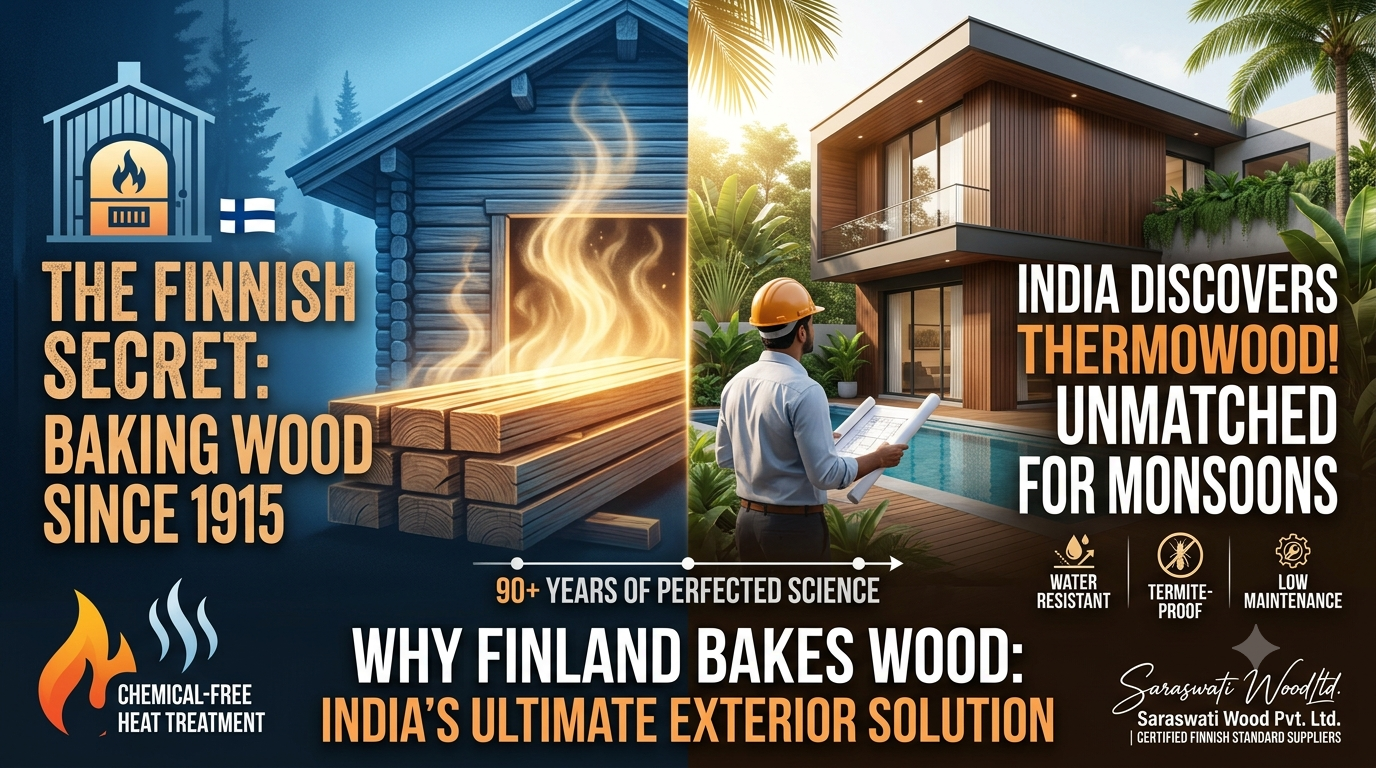
Why Finland Bakes Its Wood: A 90-Year-Old Idea India Is Just Discovering
Nearly a century of Finnish wood science has finally arrived in India. Thermowood is a non-chemical, heat treated and thermally modified product with enhanced strength and moisture resistance. In this blog, learn more about the thermal modification process and how it makes timber more resilient to all weathers and applications. Saraswati Wood Private Limited brings this Finnish-standard process to Indian builders and homeowners.
The Origin
Long before Finland turned thermally modified wood into a global export, an American kiln specialist lit the spark. In 1915, Harry Tiemann of the U.S. Forest Products Laboratory in Madison, Wisconsin, heated air-dried wood in superheated steam and found it absorbed far less moisture. The Forest Products Laboratory continued this research through the 1930s and 40s, laying the scientific groundwork nearly ninety years before the technology would reach Indian construction sites.
Why Finland Perfects the Process
Finland took up the thread decades later. In early 1990s the process was industrialised at scale by the VTT Technical Research Centre of Finland and patented in 1994. In 2000, the Finnish ThermoWood Association (now the International ThermoWood Association) was established to standardise the treatment of heating timber to 160-230 degrees Celsius in steam, with no chemicals, to permanently alter the structure of the cells. The ThermoWood Association claims the process boosts timber from Durability Class III–IV to Class I, with an outdoor life expectancy of more than 25 years, and no warping or swelling, and no vulnerability to insects, without use of synthetic preservatives. That is what makes it a truly chemical free treated wood and not just a marketing term.
Thermowood vs Chemically Treated Wood
Walk into any timber yard in India and you'll likely be steered toward chemically treated wood, cheap, widely available, and decent in ground contact. But that protection has an expiry date. The chemicals and preservatives leach out over years, and even while active, they don't actually stop moisture from seeping into the wood itself,so the wood still swells, warps, and splinters over time.
Thermowood works differently. No chemicals are injected; instead, the wood is heated and steamed until its internal structure changes permanently. That makes it genuinely chemical-free treated wood and a rich, natural color that only deepens post thermal modification. Chemically treated wood still edges ahead in constant wet or in-ground use. But for cladding, decking, and facades,the parts of a building people actually see, Thermowood is quietly becoming the smarter choice.
Why India Is Discovering It Now
India's climate is unforgiving on untreated timber, monsoon humidity, coastal salt air, and extreme heat accelerates rot and warping. As weather resistant wood for exteriors becomes a priority for architects and builders, and as teak prices climb, Thermowood is emerging as the practical middle ground: durable, low-maintenance, and free of chemical preservatives.
Where It's Used:
The most common applications include:
- Thermowood cladding and wood facade material for buildings, prized for their rich, tropical-hardwood-like tone
- Thermowood decking, including Thermo Pine cladding and Thermo Ash decking, for terraces, poolsides, and pergolas
- Low maintenance decking wood for balconies and outdoor furniture.
Price and Sourcing in India
Thermowood price in India varies by species, grade, and finish, and is best confirmed directly with certified suppliers rather than generic listings. When evaluating Thermowood suppliers in India, look for ThermoWood Association-aligned sourcing and documented durability class ratings, the same quality benchmark used across Europe.
Conclusion
Ninety years after a Wisconsin lab first heated a plank of wood, India is only beginning to build with the idea Finland perfected. As demand grows for sustainable, chemical-free alternatives to teak,IPE and any other treated wood, Saraswati Wood Private Limited is bringing this Finnish-standard thermal modification process to Indian architects, builders, and homeowners, offering Thermowood cladding and decking engineered for India's climate.

