
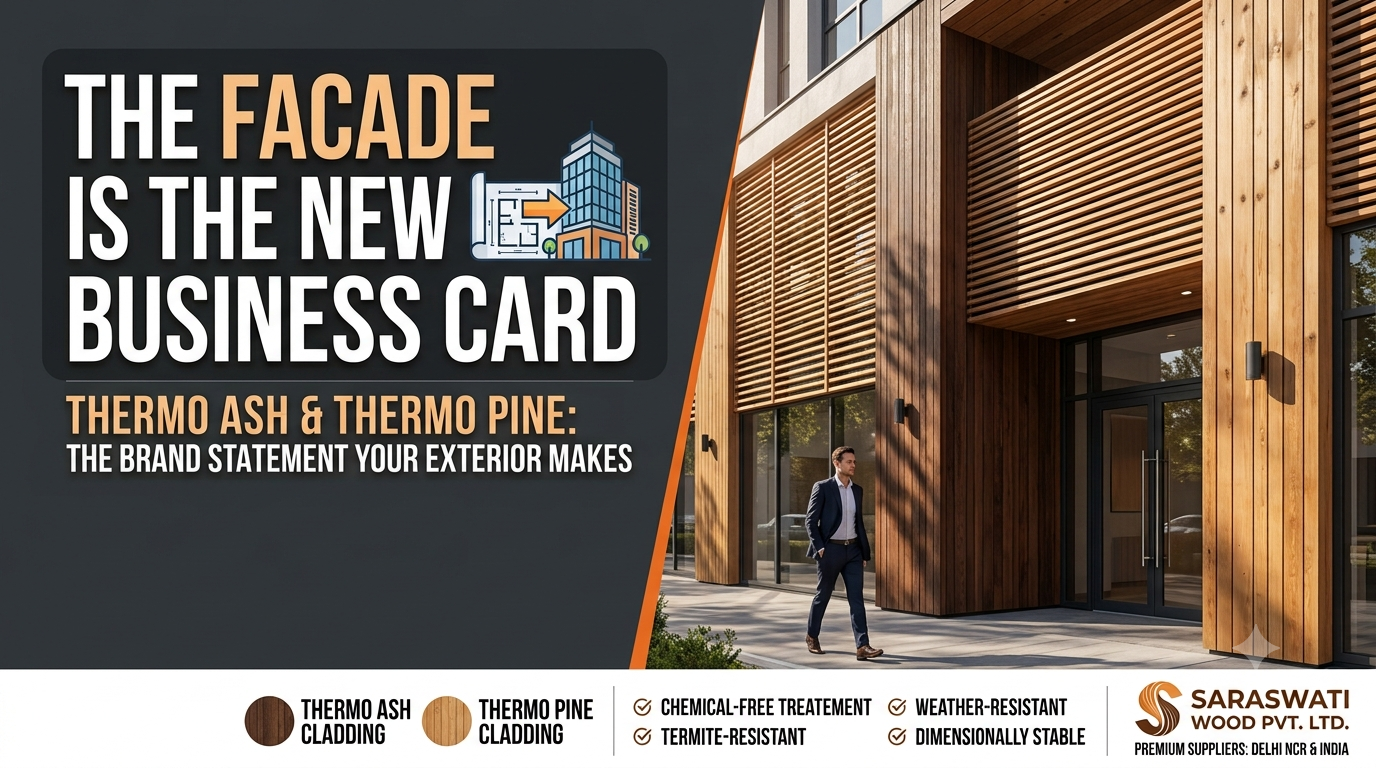
The Facade Is The New Business Card
Commercial architecture is shifting from function-first to identity-first design, and the facade is leading that shift. This blog looks at the trend driving that shift, and where thermally modified timbers, specifically Thermo Ash and Thermo Pine cladding, fits as a durable, chemical-free material answer for Indian commercial projects.
Walk past any new commercial development and the exterior probably tells you more about the brand inside than the signage does. Architects and developers have stopped treating the building envelope as just a weatherproof shell, it's become a communication tool in its own right, often the very first thing a prospective tenant or customer notices about a property, and a genuine piece of visual marketing before anyone's even stepped through the door. And it isn't just about looking good: a facade shapes energy efficiency and urban presence too, which is why architects keep reaching for more sustainable cladding materials to make buildings stand out. Metal and glass composite systems have had their run, prized for crisp finishes and easy signage integration, but as facades are increasingly expected to signal something more specific, like heritage, craftsmanship, or sustainability, natural materials are earning a bigger share of the spec sheet, since textured stone and timber carry that character in a way a glass curtain wall simply can't.
The Problem With Wood on a Commercial Exterior
The trade-off with real wood outdoors has always been durability and long term performance. Teak looks premium but comes with high cost, sourcing concerns, and heavy chemical treatment. Softer local softwoods rot, warp, or attract termites within a few seasons in India's humidity and monsoon cycles. That trade-off is exactly what thermal modification was developed to solve.
How Thermally Modified Wood Bridging the Gap
Thermal modification heats timber in a low-oxygen kiln using only heat and steam, no chemical preservatives. The heat drives out moisture and caramelizes the wood's natural sugars, which is what improves rot and insect resistance and locks in dimensional stability. Two species built on this same process now dominate commercial cladding specs: Thermo Ash and Thermo Pine.
Thermo Ash is the denser, harder-wearing of the two. Its tight, close grain gives it the highest durability class among thermally modified hardwoods, along with a deep, rich brown tone that reads as premium on an elevation, closer in character to teak or IPE than to a softwood. It resists twisting, cupping, and shrinkage well and is considered durable enough for direct exterior exposure for 25+ years when installed correctly.
Thermo Pine offers a different value proposition. It's lighter in weight (roughly 20% lighter than untreated pine after modification), which makes it easier and faster to install on larger elevations, and it takes on a warm golden-brown tone with a visible, characterful grain. It's rated for 15+ years of decay resistance in exterior use, and its lower cost relative to hardwood species makes it a practical choice for large-format cladding runs, soffits, and screening where budget and coverage area matter as much as finish.
Neither wood needs chemical preservatives, and both weather naturally to a silver-grey patina if left untreated, or can be maintained at their original tone with periodic UV oil.
Choosing Between Thermo Pine Cladding & Thermo Ash Cladding for an Indian Commercial Project
- High-visibility elevations, lobbies, entrance cladding - Thermo Ash's density and richer tone suit feature walls and street-facing facades meant to carry the "business card" impression.
- Large-coverage cladding, screening, soffits, secondary elevations - Thermo Pine's lighter weight and lower material cost make it efficient for scale without compromising on the termite and weather resistance a monsoon climate demands.
- Mixed-material facades- many commercial projects use both: Ash on the primary elevation, Pine on secondary surfaces, unified by the same warm, natural material language from street level to interior panelling.
Both outperform locally available untreated softwoods on termite resistance and require no chemical treatment to do it, which matters increasingly to clients chasing green building certifications alongside brand appeal.
The Takeaway for Architects and Developers in India
As commercial real estate competes harder on first impressions, office parks, retail fronts, hospitality projects , facade material is no longer a back-of-spec decision; it's part of the brand brief. Thermally modified wood gives architects a genuine answer: the premium look of teak or IPE, real termite and weather resistance for India's climate, and a chemical-free process that satisfies sustainability expectations, with Thermo Ash and Thermo Pine covering both ends of that brief, from statement elevations to large-scale cladding.
Conclusion
Saraswati Wood Private Limited supplies premium Thermo Ash and Thermo Pine cladding, decking, and flooring to architects, developers, and builders across Delhi NCR and India. Every board is chemical-free and engineered for termite and weather resistance in India's climate, giving commercial projects a durable, natural material for facades that are built to last.

