
What Makes IPE Wood One Of The Strongest Woods In The World?
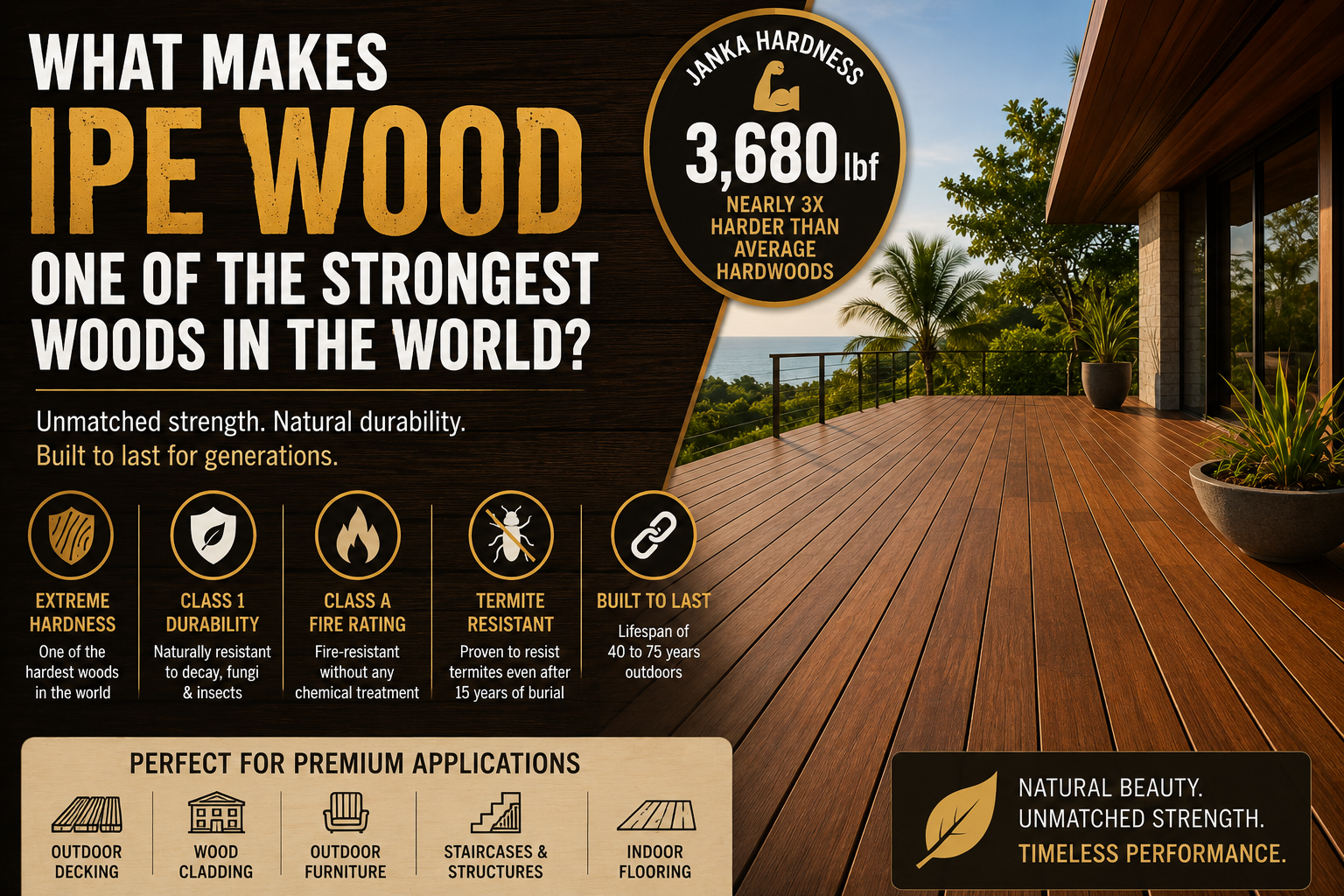
Renowned for its exceptional strength and longevity, IPE wood is one of the hardest and most durable hardwoods in the world. With a Janka hardness of up to 3,680 lbf, natural resistance to decay, termites, and fire, and a lifespan of up to 75 years, IPE is the preferred choice for premium decking, cladding, and high-performance architectural applications. Discover what makes this remarkable hardwood a benchmark for durability and timeless outdoor design.
Few materials in the world of timber command the kind of unanimous respect that IPE wood does. Architects specify it for decks designed to last half a century. Engineers rely on it where structural load-bearing performance is non-negotiable. Luxury homeowners choose it for its rare combination of beauty and near-indestructible durability. But what exactly makes IPE wood so remarkable? Here is the full picture.
What Is IPE Wood?
IPE (pronounced ee-pay) is a tropical hardwood native to Central and South America, with Brazil being the primary commercial source. It belongs to the genus Handroanthus and is commonly known as Brazilian Walnut. The trees grow slowly in dense tropical forest conditions, and it is this slow growth that gives the timber its extraordinary density, tight interlocked grain, and exceptional mechanical strength.
The Numbers Behind the Strength
The Janka hardness test measures the force required to embed a steel ball halfway into a wood sample. The average hardwood scores around 1,290 lbf. IPE wood scores between 3,510 and 3,680 lbf, nearly three times the industry average.
In practical terms: IPE wood is approximately three times stronger than cedar, twice as hard as redwood, and significantly harder than teak. Among commercially available hardwood timber, it consistently ranks in the global top three for hardness and density.
Key Properties That Set IPE Apart
Wear Resistance
IPE’s extreme density means it resists denting and surface wear far beyond what standard hardwoods can offer. The famous Coney Island boardwalk in New York was originally built with IPE wood and lasted over 25 years under heavy daily foot traffic before requiring replacement.
Class 1 Decay Resistance
IPE wood achieves a Class 1 biological durability rating, the highest classification available. This resistance is entirely natural, rooted in the wood’s density and high oil content, which prevents moisture penetration and eliminates the conditions that fungi and insects need to thrive. No chemical treatment required.
Natural Fire Resistance
IPE wood carries a Class A fire rating, the same classification as concrete and steel, without any chemical treatment. For commercial outdoor wood decking structures and hospitality projects where fire safety compliance matters, this is a significant specification advantage.
Termite Resistance
The US Naval Research Laboratory buried IPE wood samples for 15 years and found zero termite infestation, a result no other wood species has replicated in equivalent testing. For projects across India where termite activity is a real concern in outdoor applications, this natural resistance is particularly valuable.
Dimensional Stability
IPE’s interlocked grain resists warping, cupping, and splitting across seasonal humidity and temperature swings, making it a long-term performer in India’s demanding climate conditions.
Where IPE Wood Is Used
IPE wood India is most commonly specified for outdoor wood decking around pools, terraces, seafront promenades, and resort walkways, where its moisture, UV, and biological decay resistance ensures decades of performance. It is also used for exterior sustainable wood cladding on high-end residential and commercial buildings, outdoor furniture and staircases requiring structural strength, and premium indoor wooden flooring in luxury homes and commercial spaces with heavy foot traffic demands.
A Note on Sustainability
IPE’s slow growth and high global demand make responsible sourcing essential. Always look for FSC-certified or PEFC-certified IPE wood from verified suppliers. When sourced responsibly, IPE’s extraordinary lifespan, 40 to 75 years in outdoor conditions, actually makes it one of the lower lifecycle-impact timber choices available, requiring far fewer replacement cycles than conventional alternatives.
Conclusion
IPE wood earns its reputation through measurable, verified performance: a Janka hardness nearly three times the average, a natural lifespan of up to 75 years, Class 1 decay resistance, Class A fire rating, and proven termite resistance. For projects where longevity and performance are the primary brief, IPE wood belongs at the top of the material shortlist.
Saraswati Wood Private Limited, a trusted Thermowood supplier in Delhi and experienced timber supplier Delhi NCR, sources and supplies premium IPE wood India for decking, cladding, and flooring applications. With over two decades of expertise and certified sourcing, our team will help you specify and supply the right IPE product for your project.

