
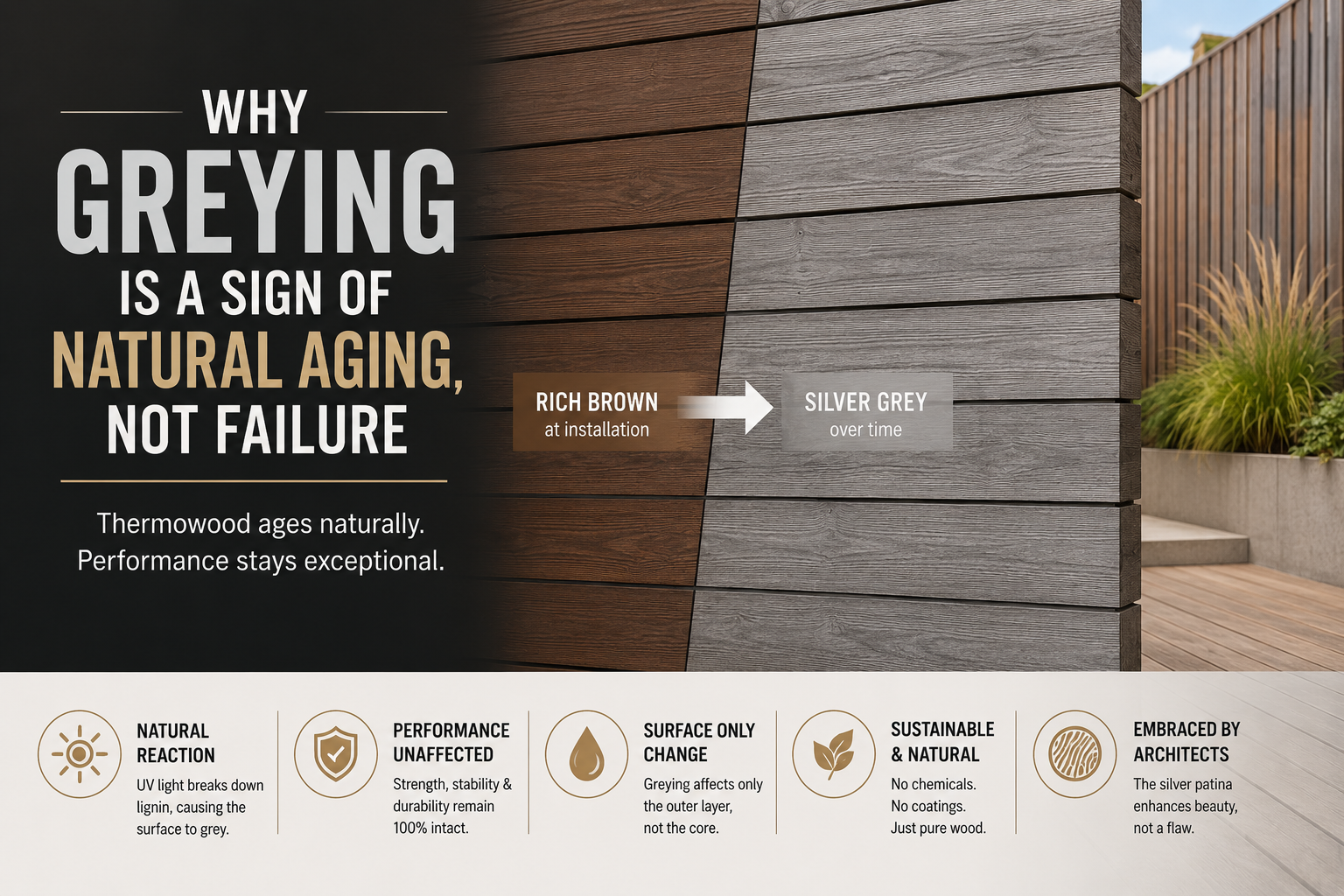
Why Greying Is A Sign Of Natural Aging, Not Failure In Thermowood
Noticing your Thermowood turning silver-grey? That’s not deterioration—it’s natural aging. This article explains why UV exposure creates a beautiful grey patina without affecting strength, stability, or durability, and why architects increasingly embrace weathered Thermo Oak for sustainable cladding, decking, and contemporary outdoor spaces.
It happens to almost every homeowner installing Thermowood outdoors for the first time. A few months after installation, the rich deep-brown colour begins shifting, softening, lightening, and gradually settling into a cool silver-grey tone. The immediate reaction is often concern. Has something gone wrong? Is the wood degrading?
The answer is no. Once you understand what is actually happening, that silver-grey tone starts looking less like a problem and more like the material doing exactly what it should.
What Causes the Greying?
The greying of Thermowood is driven by UV radiation. Sunlight breaks down lignin, a compound in the wood’s cell wall responsible for its natural brown colour. As lignin at the surface degrades, the warm tone fades and a silver-grey patina gradually forms. Moisture accelerates the process: rain washes away degraded lignin and contributes to a more even surface tone.
Critically, this process is entirely limited to the outermost layer of the wood. It is a surface colour change, not a structural event.
Does Greying Affect Performance?
No. This is the question that matters most, and the answer is unambiguous.
The thermal modification process that defines Thermowood, high-temperature, steam-based treatment in an oxygen-free environment, runs through the full depth of every board. It permanently reduces moisture absorption and removes the biological nutrients that fungi, bacteria, and insects depend on. None of this is reversed or diminished by surface greying.
A Thermo Oak board that has turned fully silver-grey on the outside retains exactly the same moisture resistance, dimensional stability, and biological decay resistance as the day it was installed. Greying is cosmetic. The wood’s structural performance remains completely intact.
How Quickly Does It Happen?
The timeline depends on climate, orientation, and exposure. IThis variation is also what gives Thermowood facades their character. Boards in full sun grey faster than those under an eave, creating subtle tonal differences across a surface that reads as natural and organic, a quality synthetic materials cannot replicate.
Why Architects Are Embracing the Grey Patina
A growing number of architects and designers do not just accept the greying, they actively specify it.
The silver-grey tone of naturally weathered Thermowood has become one of the most sought-after exterior finishes in contemporary architecture. It pairs beautifully with concrete, glass, and Corten steel, materials central to the visual language of modern buildings. It is maintenance-free once achieved, and carries a natural, sophisticated character that surface treatments can only approximate. In premium residential and hospitality projects across India, untreated Thermo Oak cladding and Thermo Oak decking is increasingly specified with the explicit intent of achieving this weathered finish.
Two Approaches: Embrace It or Preserve the Brown
Both are entirely valid. For those wanting to retain the original deep-brown tone, apply a UV-resistant oil after installation and reapply periodically, once every one to two years in fully exposed outdoor settings is typically sufficient. For those happy to let the wood age naturally, no maintenance is needed beyond routine cleaning and inspection of fixings. Neither approach affects the wood’s long-term structural performance.
Conclusion
Greying in Thermowood is not a defect or a cause for concern. It is the natural, structurally harmless response of a high-performance timber to sunlight, and one that many leading architects now design around deliberately. Beneath every silver-grey board, the wood is performing exactly as intended. Saraswati Wood Private Limited, a trusted Thermowood supplier in Delhi and timber supplier across Delhi NCR, offers FSC-certified Thermo Oak India and Thermowood products alongside expert guidance on finishing and specification. Reach out to our team to find the right solution for your project.

